In 1463, London outlawed the shoes of its fanciest men. These dapper lords had grown ridiculous in their dapperness, and had taken to ambling streets shod in long, carrot-shaped shoes that tapered to impish tips, some as long as five inches beyond the toe. These shoes were called “crakows” or “poulaines” (a term also used to refer to the tips alone), and the court of King Edward IV eventually found them offensive enough to pass a sumptuary law prohibiting shoe tips that extended over two inches beyond the toe. atlasobscura.com
Given at the Theoretical Archaeology Group Conference on December 19, 2017.
Abstract: There have been various approaches applied to study and understand the nature of the late Medieval book, including historical, palaeographical and codicological methods, and yet, traditionally, little attention has been given to the book as a form of material culture, especially by archaeologists. This paper will briefly discuss the different approaches that have been applied in recent years to the study of the book, before giving a detailed consideration of how the archaeological investigation into late Medieval book fittings excavated from English monastic sites offers an innovative approach to the wider study of the late Medieval book.
To move beyond simply defining the various types of late Medieval book fittings, an interdisciplinary approach can be applied to further understand the nature of this type of material culture, including the books on which fittings were used, the influences of different monastic orders, their geographical distribution and the significance of their deposition. It is the purpose of this paper to demonstrate how the archaeological investigation of book fittings provides not only the opportunity to study book fittings typologically but also to place such material culture into its wider social and cultural contexts within late Medieval society. medievalists.net
A remembrance of Richard III, and my gift to true Ricardians everywhere. With gratitude to Blackmore’s Night and their song, ‘Village Lanterne,’ which inspired me, and to Matthew Lewis (author of ‘Loyalty’, ‘Honour’, and ‘The Survival of the Princes in the Tower’) for his help and kindness in bringing this to fruition.
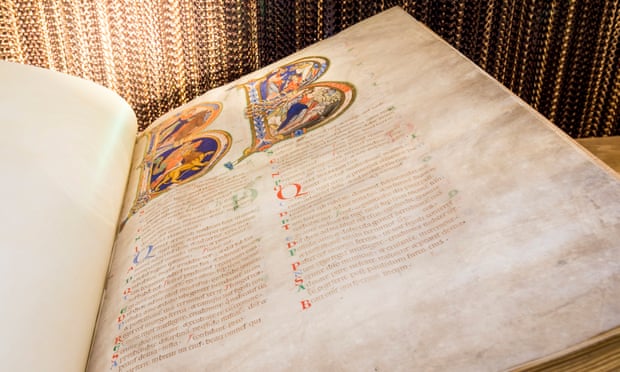
Unfinished 12th-century book will be shown along with royal bones at Winchester Cathedral.
Using a goose feather quill, a solitary scribe spent four years writing the words in Latin on the skins of 250 calves, before six artists began sumptuous illuminations using gold leaf and lapis lazuli from Afghanistan. Although it was never quite finished, the Winchester Bible finally weighed in at the medieval equivalent of 32kg. theguardian.com
If you want to know what really mattered to a medieval king or queen, look at what they called their children. The names given to royal offspring reveal rebellious, pious and pretentious parents. By Rachel Tod. HistoryToday.com
Maeve L’Estrange is a culinary archaeologist, studying for a PhD in experimental archaeology in UCD. Since no medieval Irish recipes survive, she tries to piece together what may have been eaten by examining the fauna and flora remains from excavation reports and combining these with spices and other foodstuff referred to in primary documents of the period. DublinInquirer.com
IN THE MIDDLE AGES, CREATING a book could take years. A scribe would bend over his copy table, illuminated only by natural light—candles were too big a risk to the books—and spend hours each day forming letters, by hand, careful never to make an error. Atlasobscura.com
You may have heard how medieval rulers have been killed in battle or died from an assassin’s blade. But did you know about the king who died from uncontrollable laughing or the emperor who was dragged 16 miles through a forest by a deer? Check out our list of the top ten strangest deaths from the Middle Ages! Medievalists.net




 Richard III Society