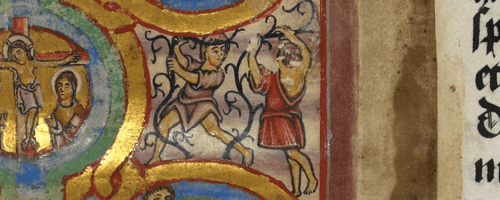
Pluck. Crush. Cork. Medieval calendars remind us that September is the month for making wine. If planting and pruning vines fall to the month of March, September is the time for cashing in on all the effort. Blogs.bl.uk

Pluck. Crush. Cork. Medieval calendars remind us that September is the month for making wine. If planting and pruning vines fall to the month of March, September is the time for cashing in on all the effort. Blogs.bl.uk

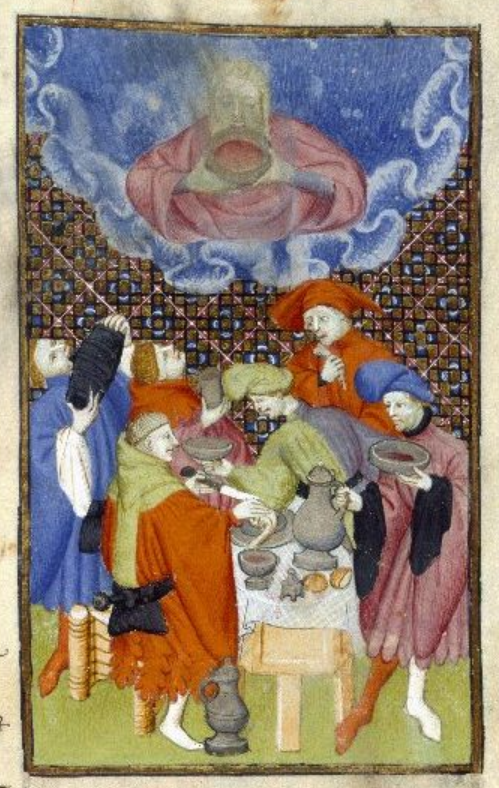
Diluting wine with water, also known as baptising wine, was a common medieval practice. Taverners (innkeepers) and vintners (wine merchants) were especially associated with this custom. Literary accounts sometimes depicted them as nefarious figures who mixed wine with water in order to maximize their profit. Ironically, at the same period drinking diluted wine was associated with the virtue of temperance; in contrast, the excessive drinking of wine was associated with the deadly sin of gluttony (gula).
The Joyful Ballad is essentially a catalogue of curses that the poet wished upon taverners who diluted their wine. Although its author is unknown, it has long been associated with François Villon (c. 1431–after 1463), one of the most renowned French poets of the late Middle Ages, but also a murderer, thief and vagabond. blogs.bl.uk

“B. to his venerable master A., greeting This is to inform you that I am studying at Oxford with the greatest diligence, but the matter of money stands greatly in the way of my promotion, as it is now two months since I spent the last of what you sent me. The city is expensive and makes many demands; I have to rent lodgings, buy necessaries, and provide for many other things which I cannot now specify. Wherefore I respectfully beg your paternity that by the promptings of divine pity you may assist me, so that I may be able to complete what I have well begun. For you must know that without Ceres and Bacchus Apollo grows cold.” Medievalists.net

On the 29th of August 1475, the Treaty of Picquigny was signed. meanderingthroughtime.weebly.com


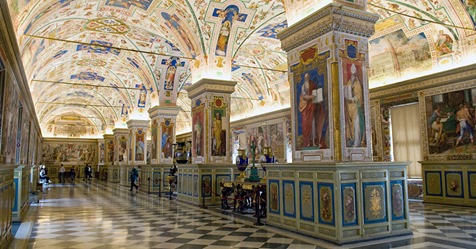
75,000 codices, 85,000 incunabula and more than a million books have gradually been uploaded to the site. Alteia.org
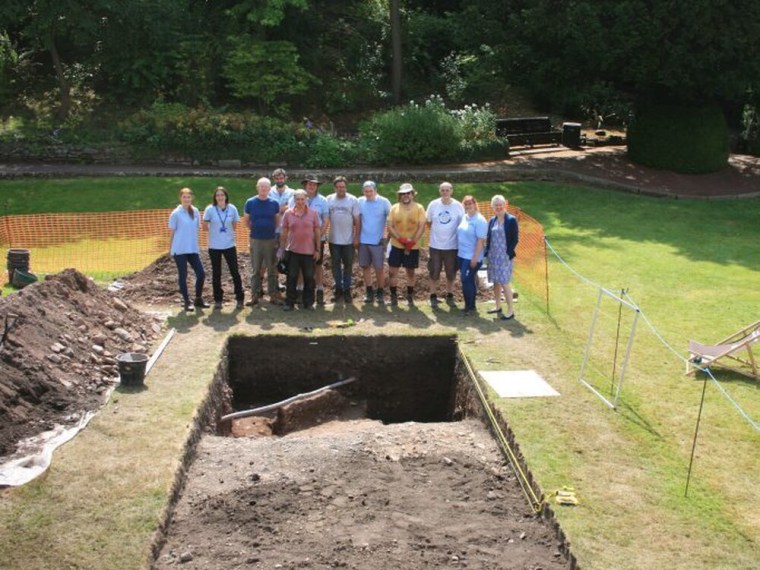
The first-ever excavation of Shrewsbury Castle has been hailed a huge success after producing finds of national significance. ShropshireStar.com

The unicorn is an enduring image in contemporary society: a symbol of cuteness, magic, and children’s birthday parties.
But while you might dismiss this one-horned creature as just a product for Instagram celebrities and five-year-old girls, we can trace the lineage of the unicorn from the 4th century BCE. It evolved from a bloodthirsty monster, to a tranquil animal bringing peace and serenity (which can only be captured by virgins), to a symbol of God and Christ. TheConversation.com


Crowds clog Edinburgh’s Royal Mile, the main artery between Edinburgh Castle and Holyrood Palace. The road is dotted with stores selling Nessie trinkets and lined with bagpipers and street performers pulling off dazzling tricks. But look beyond the tartan tourist traps, and you’ll discover tucked-away gardens, remnants of the city’s medieval past, and much more. AtlasObscura.com

In July of 1535, King Henry VIII and his court of over 700 people embarked on an epic official tour. Over the next four months the massive entourage would visit around 30 different royal palaces, aristocratic residences and religious institutions. While these stops were important PR events for the king, designed to spark loyalty in his subjects, royal households had another reason entirely for their constant movement. History.com
Mark McGettigan found what turned out to be the first of three lost medieval sculptured stones at Govan Old Parish Church in Glasgow. belfasttelegraph.co.uk