The Wars of the Roses were a series of bitter conflicts that tore apart England and Wales during the late middle ages, killing tens of thousands of people, sending the crown bouncing back and forth between the houses of Lancaster and York – and eventually leading to the collapse of the Plantagenet dynasty and the rise of the Tudors. telegraph.co.uk
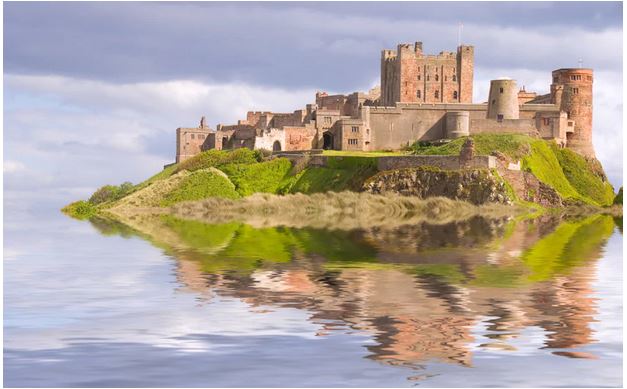
One of the most strikingly preserved fortresses in England, Bamburgh Castle sits on a windswept headland in Northumberland
Read more from Dan Jones, author of The Hollow Crown.
The Wars of the Roses was a bloody contest for the throne of England, a civil war fought out between the rival houses of York – whose symbol was the white rose – and Lancaster – whose symbol was the red rose – throughout the second half of the 15th century.
After 30 years of political manipulation, horrific carnage and brief periods of peace, the wars ended and a new royal dynasty emerged: the Tudors. HistoryHit.com
Read more to discover 16 key figures from the wars.
The latest podcast from History Today looks at the rise and fall of the House of York in 1483.
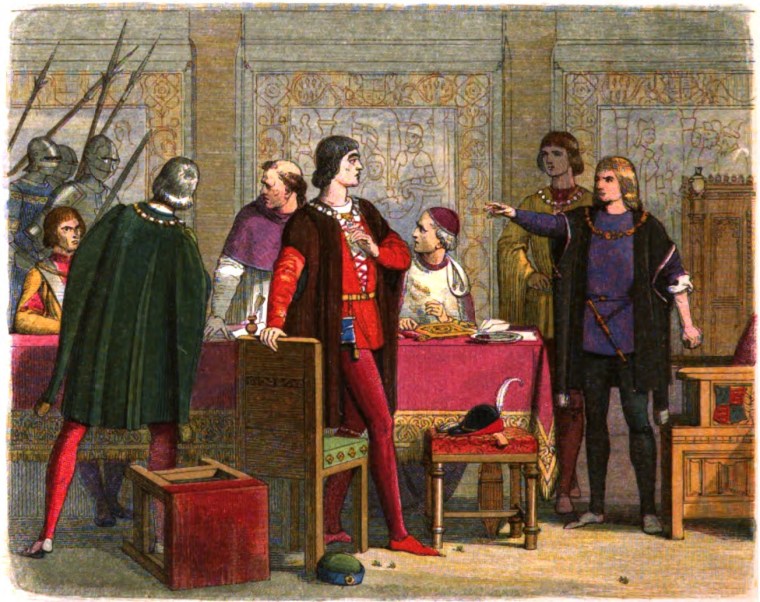
Richard, acting as Lord Protector, orders the arrest of William Hastings, 1st Baron Hastings. From ‘A Chronicle of England: B.C. 55 – A.D. 1485’, c. 1864. Wiki Commons.
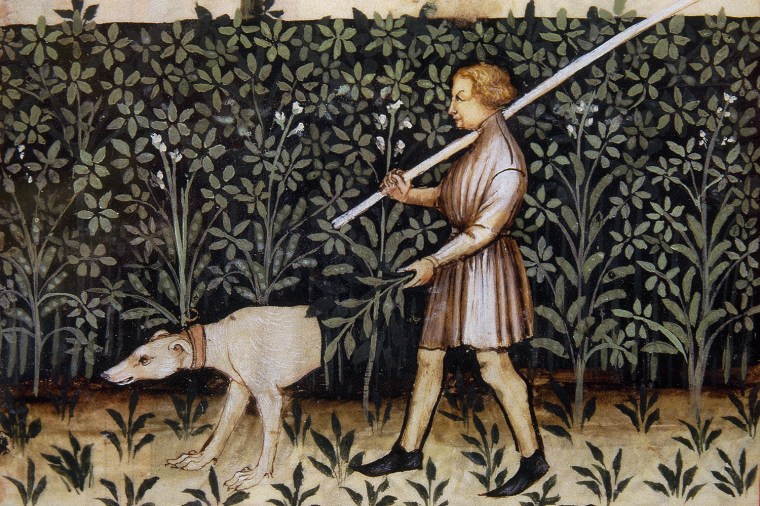
The people of medieval Europe were devoted to their dogs; one great French dog-lover declared that the greatest defect of the species was that they ‘lived not long enough’.
Detail from Tacuinum Sanitatis, 14th century medieval handbook of health.
The later middle ages, and the years immediately following, were one of the most ‘doggy’ periods in history. Hunting and hawking were by far the most popular sports of the leisured classes, who also liked keeping dogs simply as pets; and the rest of the population used them for protection and herding. Performing dogs were much admired, and people loved to hear fabulous yarns of the extraordinary fidelity and intelligence of dogs. historytoday.com
This stone set into the wall at the west end of Beaumont Street is understood to have been erected by Alan Brown, a former Vice-Provost of Worcester College. It was restored by Worcester College in 2004, after it was hit by a vehicle in 2003 and left lying in the hedge of 24 Beaumont Street. oxfordhistory.org.uk
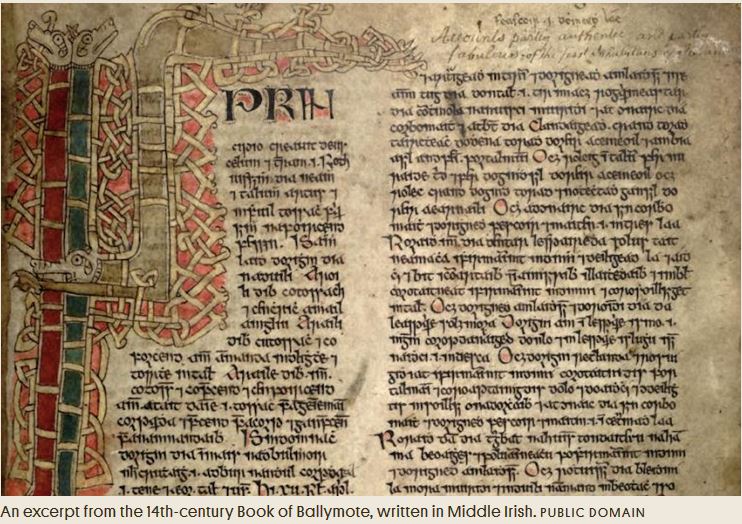
A tiny group of scholars added 500 words and made 5,000 revisions to the Dictionary of the Irish Language. AtlasObscura.com
Updating the lexicon of a thousand-year-old language may seem like a foolish task for anyone living in the 21st century. But understanding the words medieval people used offers insight into the lives they lived—how they behaved, what they believed, and how they saw the world, says Máire Ní Mhaonaigh, a medievalist at Cambridge, who worked with Arbuthnot, in a press release.
Visitors come to Hereford Cathedral each year to wonder at one of the world’s greatest Medieval works – the Mappa Mundi. But this visit offers another unique treasure – The Chained Library.
Here 229 Medieval manuscripts including the 8th century Hereford Gospel and books from later centuries are preserved, each chained for security to the library shelves as they were in the 17th century. While such libraries previously existed throughout Europe only the Hereford Chained Library has survived.
In this programme the Cathedral’s librarian Dr Rosemary Firman takes us on a tour and tells its story. historywm.com
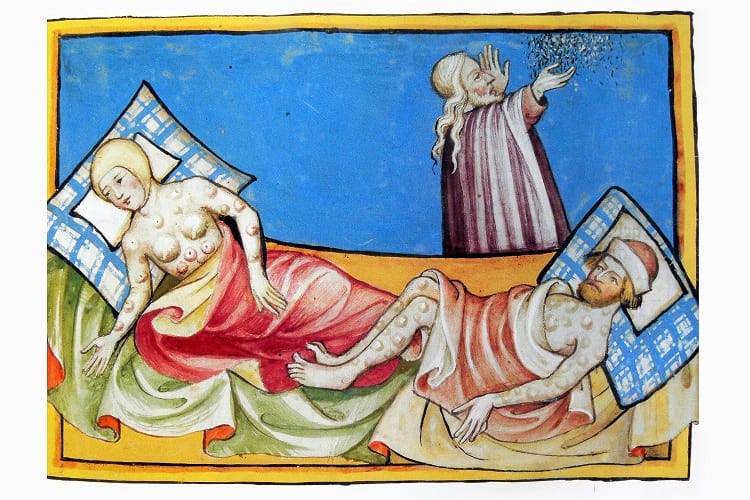
A cruel fact about life is that diseases exist. Especially infectious, life-threatening variants that once spread can kill millions of people in a short space of time, in very painful circumstances. An example is smallpox which is estimated to have killed between 300-500 million people in the last 12,000 years. Still, no cure exists, but vaccinations are very effective at stemming the development of the disease. Another is bubonic plague, a bacterium-based disease which wreaked havoc in Europe and Asia, most infamously in the year 1346. The devastation was so serious that it became known as the Black Death, with the Latin word for terrible, mistranslated to black. Although for many, both terrible and black perfectly explains the dark situation throughout the Old World at this time. ststworld.com
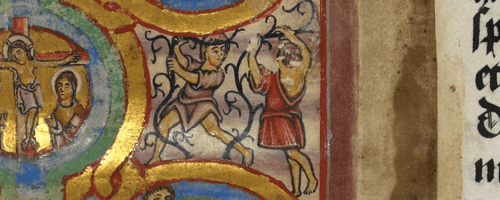
Pluck. Crush. Cork. Medieval calendars remind us that September is the month for making wine. If planting and pruning vines fall to the month of March, September is the time for cashing in on all the effort. Blogs.bl.uk
The depiction of the parable of the Labourers in the Vineyard in the Stavelot Bible takes us closer to the toil involved in tending the vines: Add MS 28106, f. 6r
Diluting wine with water, also known as baptising wine, was a common medieval practice. Taverners (innkeepers) and vintners (wine merchants) were especially associated with this custom. Literary accounts sometimes depicted them as nefarious figures who mixed wine with water in order to maximize their profit. Ironically, at the same period drinking diluted wine was associated with the virtue of temperance; in contrast, the excessive drinking of wine was associated with the deadly sin of gluttony (gula).
The Joyful Ballad is essentially a catalogue of curses that the poet wished upon taverners who diluted their wine. Although its author is unknown, it has long been associated with François Villon (c. 1431–after 1463), one of the most renowned French poets of the late Middle Ages, but also a murderer, thief and vagabond. blogs.bl.uk
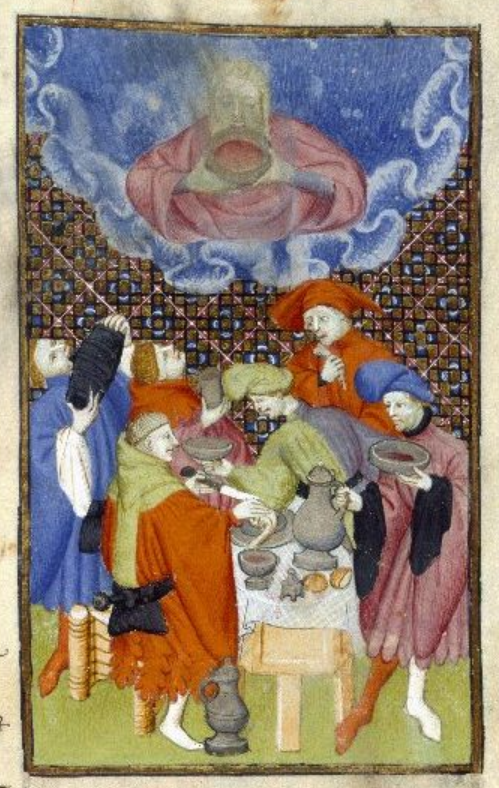
Bacchus and his followers as examples of gluttony, in Christine de Pizan’s L’Épître Othéa (France, c. 1410–c. 1414): Harley 4431, f. 106r


 Richard III Society